Nathalie Bardin
Director General of YSEND. Corporate and publication responsibilities remain governed by the registered company structure.
About XMS Cloud
XMS Cloud is logistics operations software for teams that need warehouse, transport, automation, client work, and billing to share one controlled context.
Corporate identity
YSEND GROUP is the public trading identity of the registered French company YSEND, which publishes and operates the XMS Cloud platform.
Leadership and operating footprint
Public registry and company information reviewed on 22 July 2026 identify the current governance and operating locations below.
Director General of YSEND. Corporate and publication responsibilities remain governed by the registered company structure.
Registered President of YSEND. The formal named website publication director remains subject to legal confirmation.
Registered head office and European operating base at 357 Chemin des Iscles, 06700 Saint-Laurent-du-Var.
YSEND GROUP publishes an operating presence in Baiyun District, Guangzhou, supporting China-to-Europe logistics activity.
Product focus
The platform follows demand from product and order identity through physical work, shipment, proof, cost, and settlement. It gives each role an appropriate surface without creating a separate source of truth for every device.
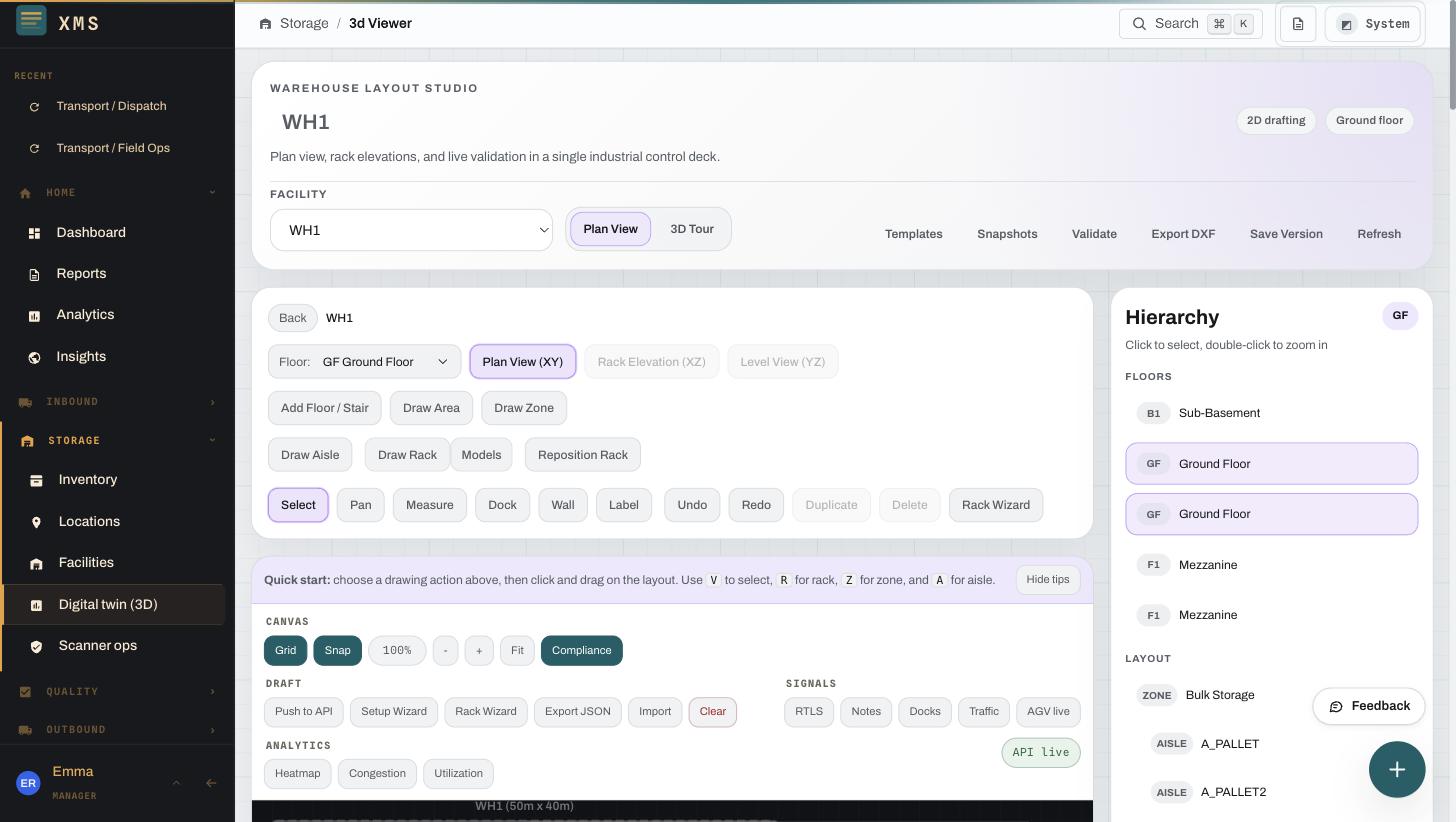
How the product is delivered
The deployment identifies who operates each physical process and which warehouse, carrier, robot, or machine system remains authoritative.
Application modules, APIs, workflow state, audit, role surfaces, orchestration, and evidence contracts.
Sites, workforce, carrier contracts, physical execution, safety, operating procedures, and service commitments.
Configuration, integration, data migration, edge devices, automation qualification, testing, training, and cutover.
Delivery layers
Each layer has a different owner and is established at a different point in the implementation.
Application state, contracts, guards, workflows, interfaces, and automated tests ship with XMS Cloud.
Credentials, carrier accounts, equipment dialects, topology, operating policy, and support are configured for the site.
Throughput, availability, implementation duration, and operating outcomes come from the deployed environment.
Operating model FAQ
XMS Cloud provides logistics operations software. The customer, its 3PL, its carriers, or another contracted partner operates the physical process.
Yes. Run customer sites and carrier accounts, or connect partner-operated execution while preserving shared operational context.
It can replace selected warehouse or transport systems, introduce one module first, or integrate systems that remain authoritative.
The contracted carrier, fulfilment operator, or service provider invoices physical services. Software, implementation, and third-party pass-through costs remain separately scoped.
Data remains tenant-scoped and exportable. Ownership, controller and processor roles, retention, deletion, and exit obligations must be stated in customer and data-processing terms.
Start with the operation
Review the work, owners, devices, exceptions, proof, and cost before selecting modules.