Demand
Order, replenishment, storage, sort, packaging, and exception work enters the shared task engine.
Warehouse automation orchestration
Translate warehouse demand into governed missions across autonomous guided vehicles, autonomous mobile robots, robot cells, sortation, put-to-wall, storage equipment, and packaging—without taking motion or safety authority from machine controllers.
Mission, not motion
XMS Cloud assigns and reconciles missions at the WES/WCS boundary. Vendor controllers and PLCs retain the device-level authority they are designed to hold.
Order, replenishment, storage, sort, packaging, and exception work enters the shared task engine.
Match resource capability, priority, location, lease, safety state, and business constraint.
Send a governed mission through the configured vendor, fleet, cell, WCS, or PLC adapter.
Compare intended, commanded, acknowledged, observed, and completed state; escalate divergence.
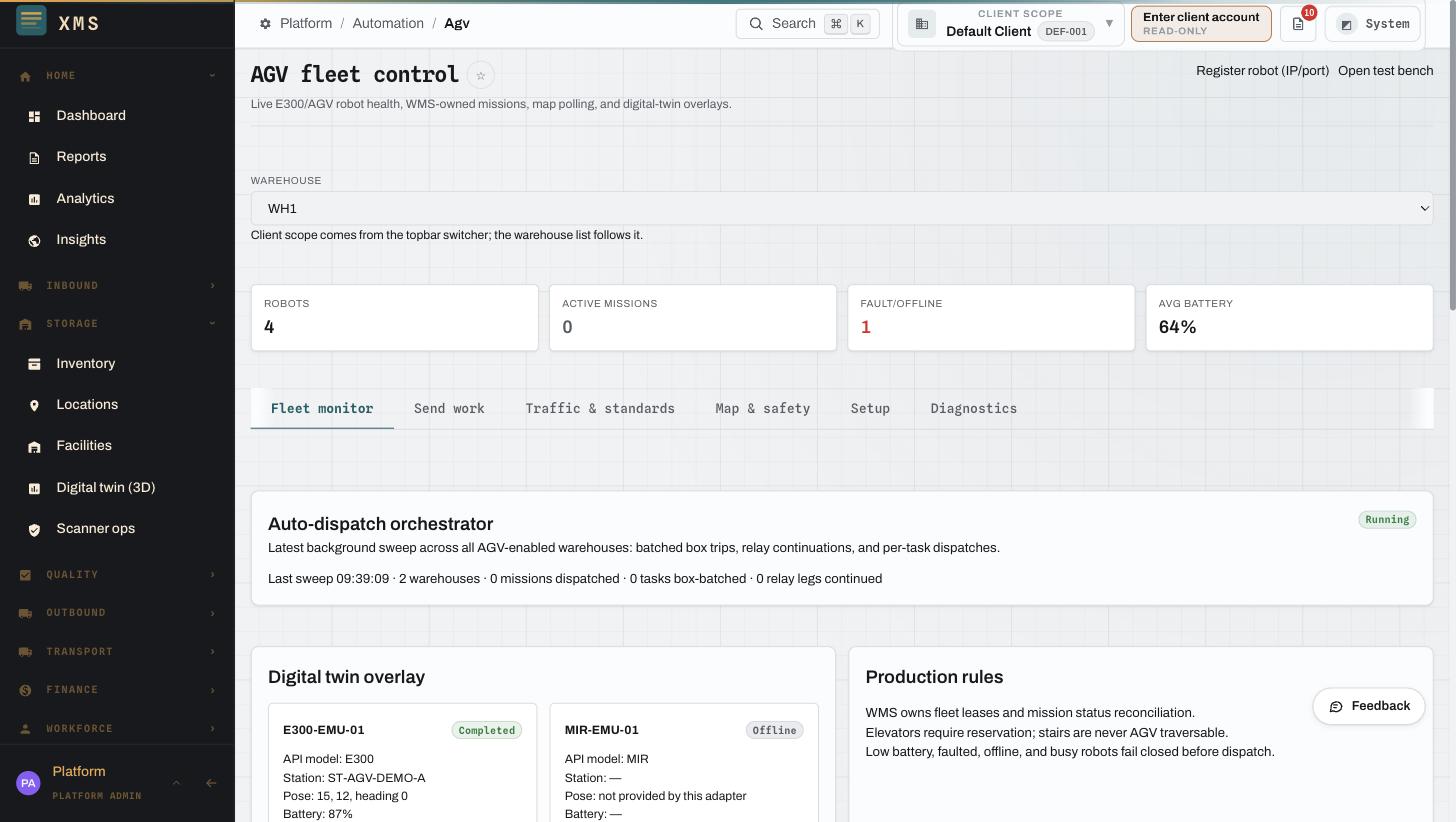
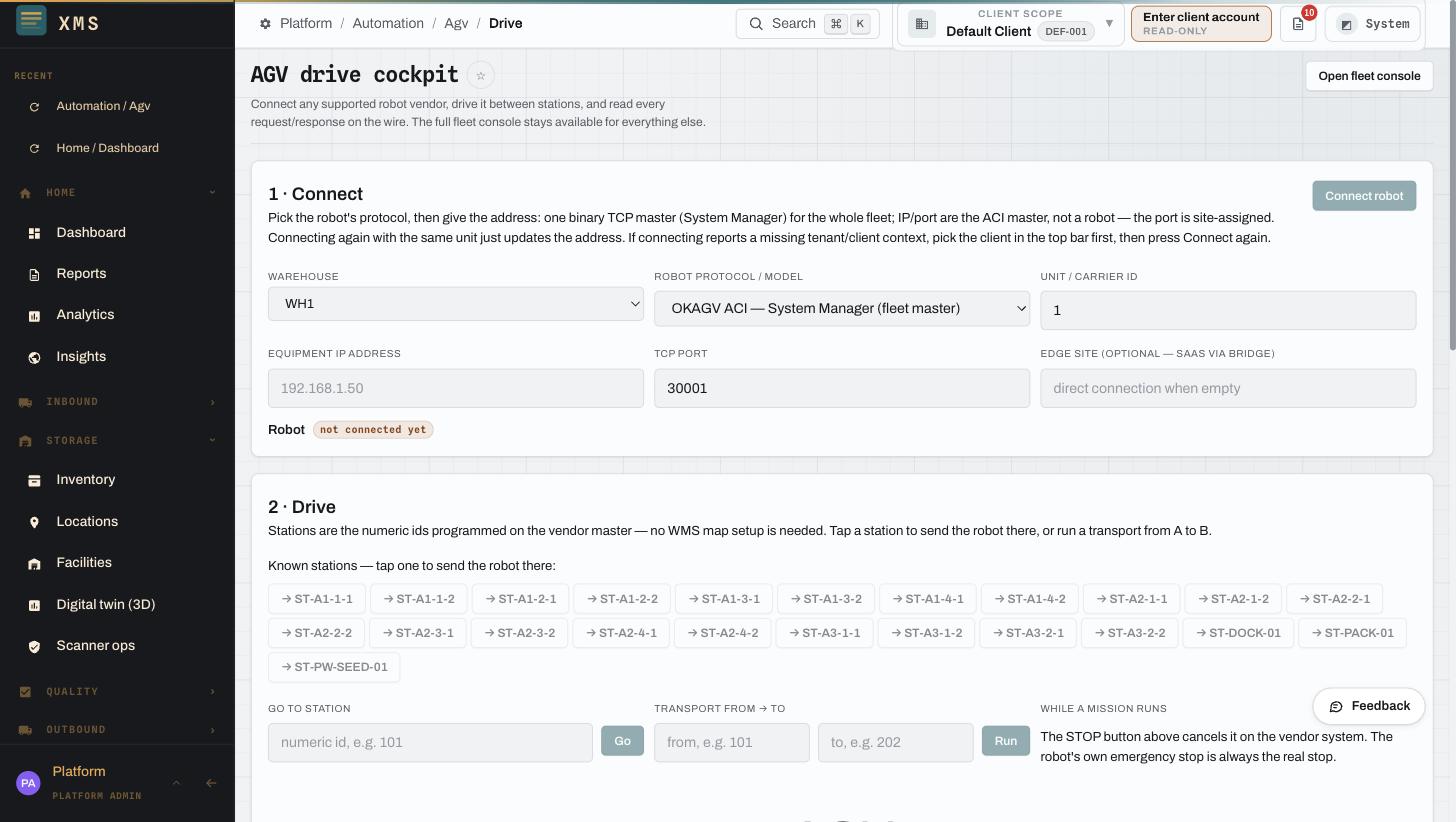
AGV fleet control
Supervise robot health, battery, pose, mission, reservations, keep-out zones, and digital-twin overlays without flattening vendor-specific capabilities.
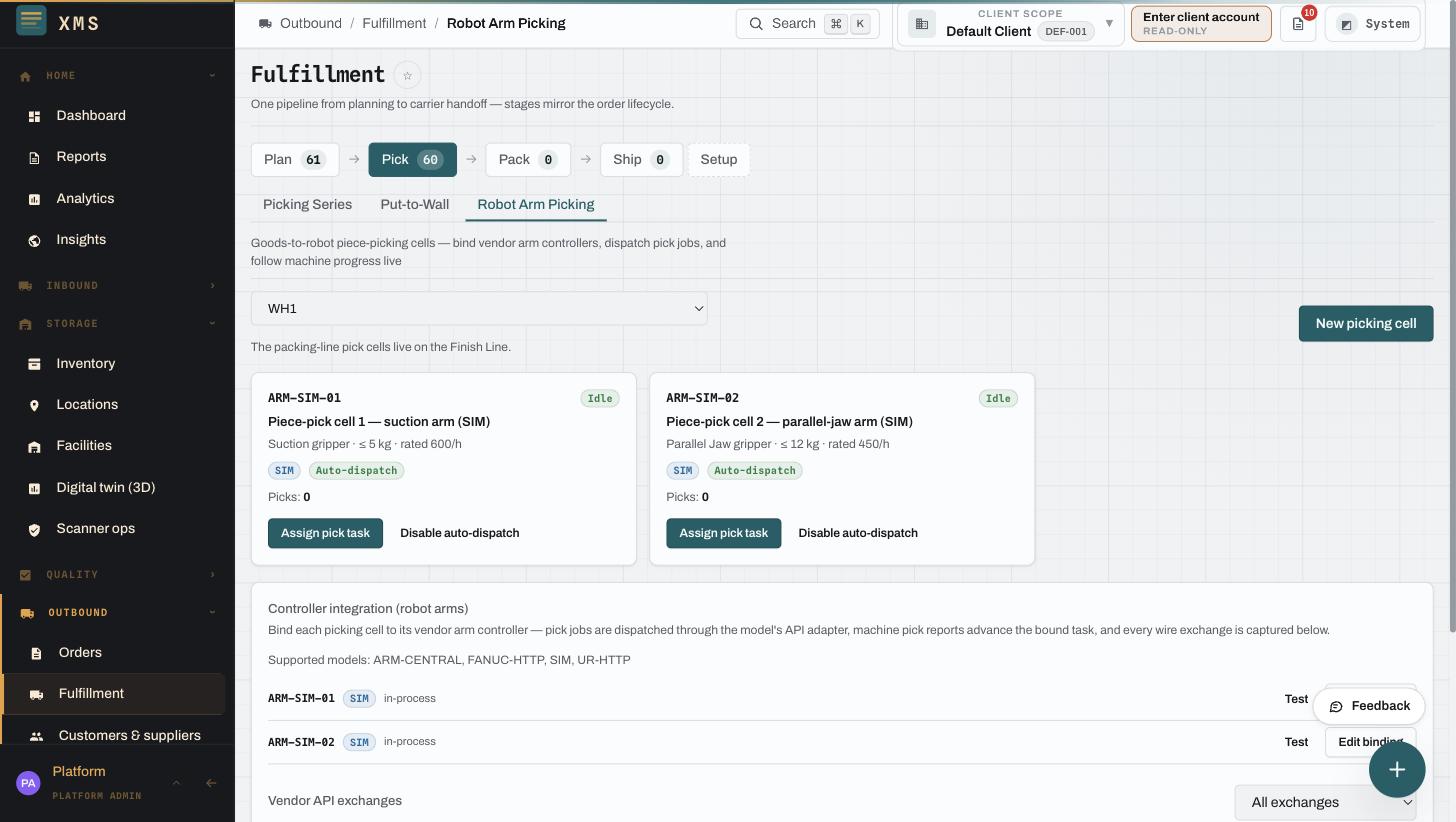
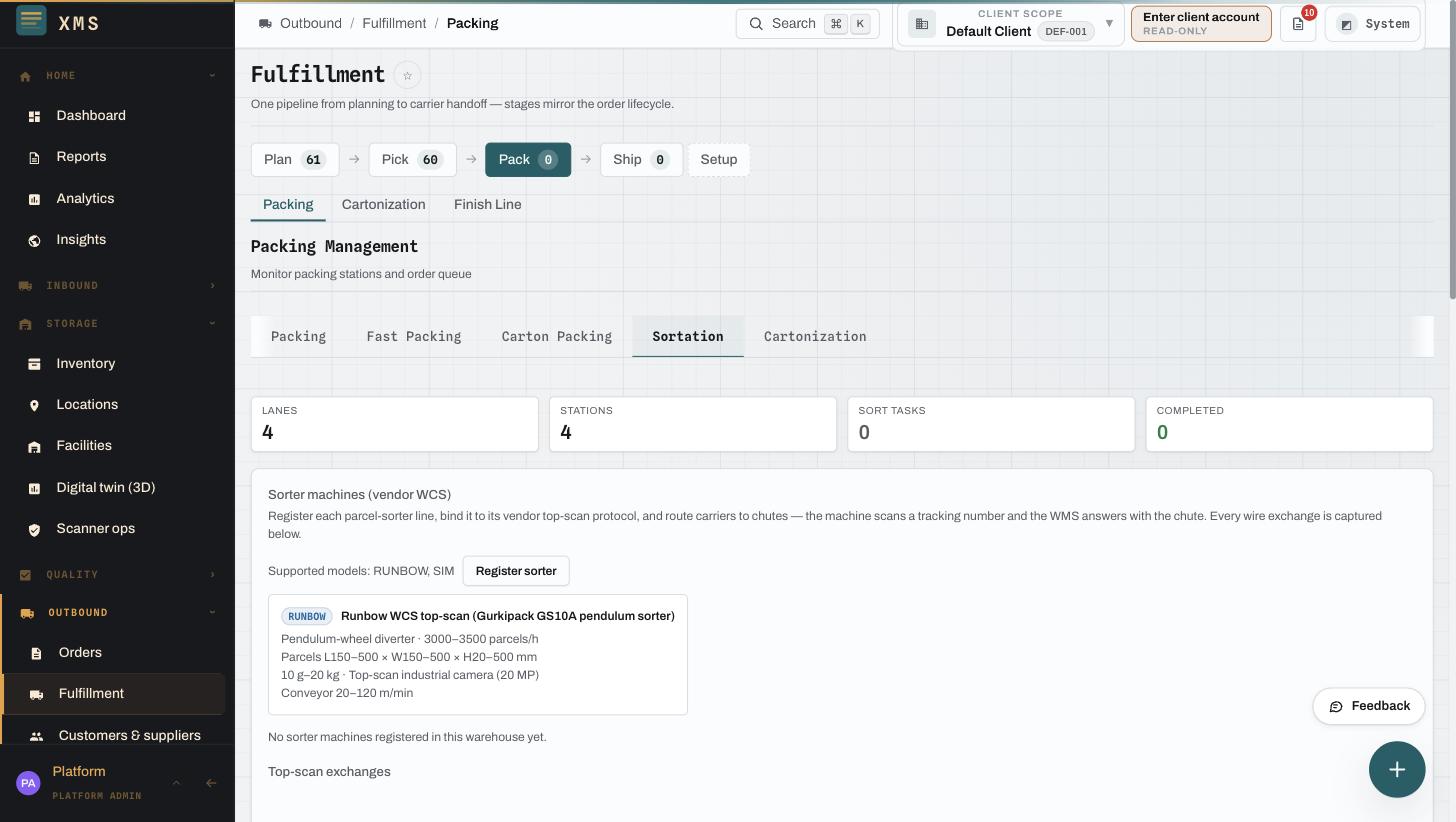
Automation lanes
Dispatch piece-pick work, account for gripper capability, track lanes and stations, and reconcile machine reports.
Bind walls, slots, orders, PTL controllers, scans, exceptions, and completion to the same fulfilment state.
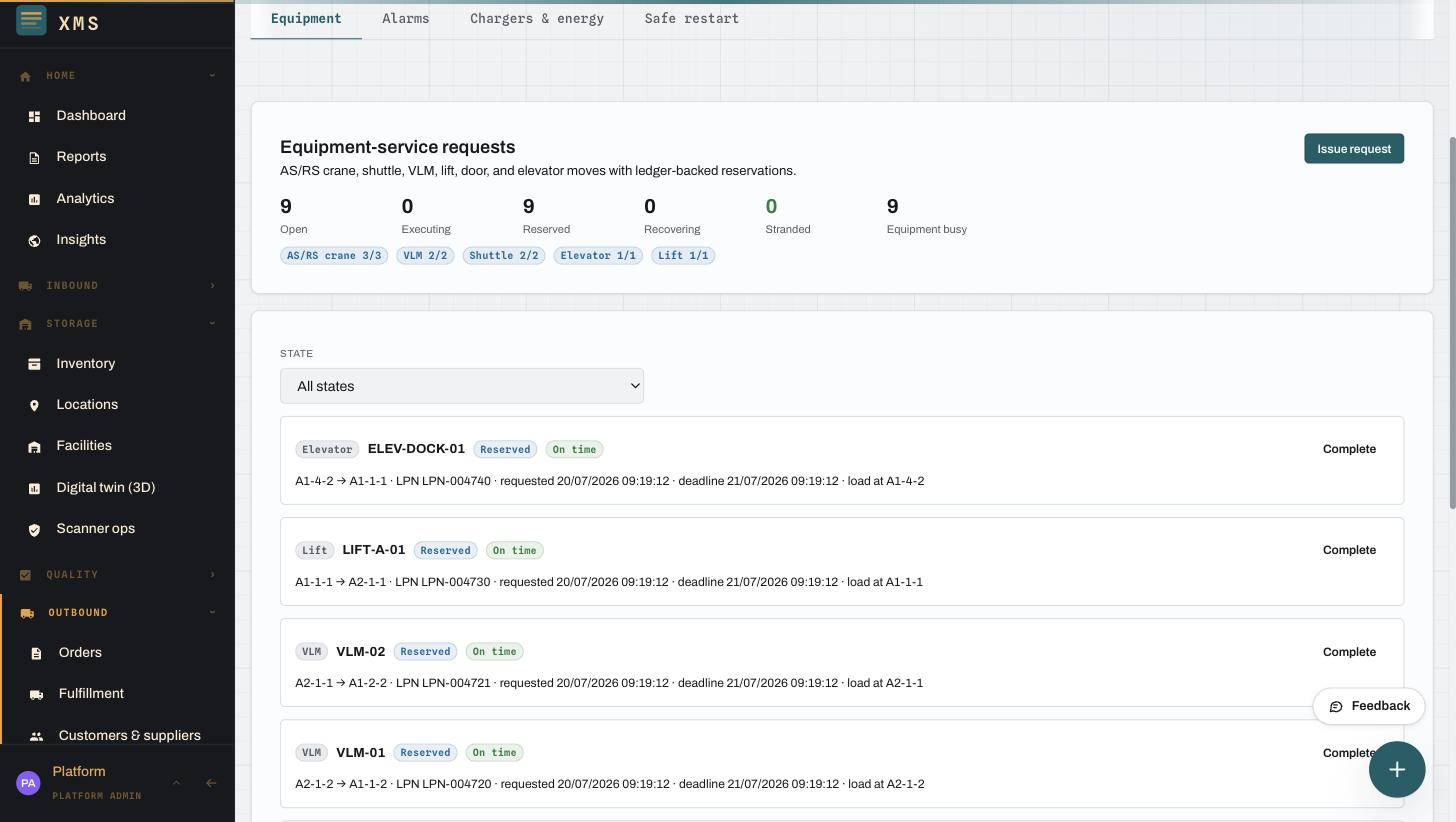
Queue service, lease shared resources, detect divergence, and guide safe restart without hiding PLC ownership.
Finish line
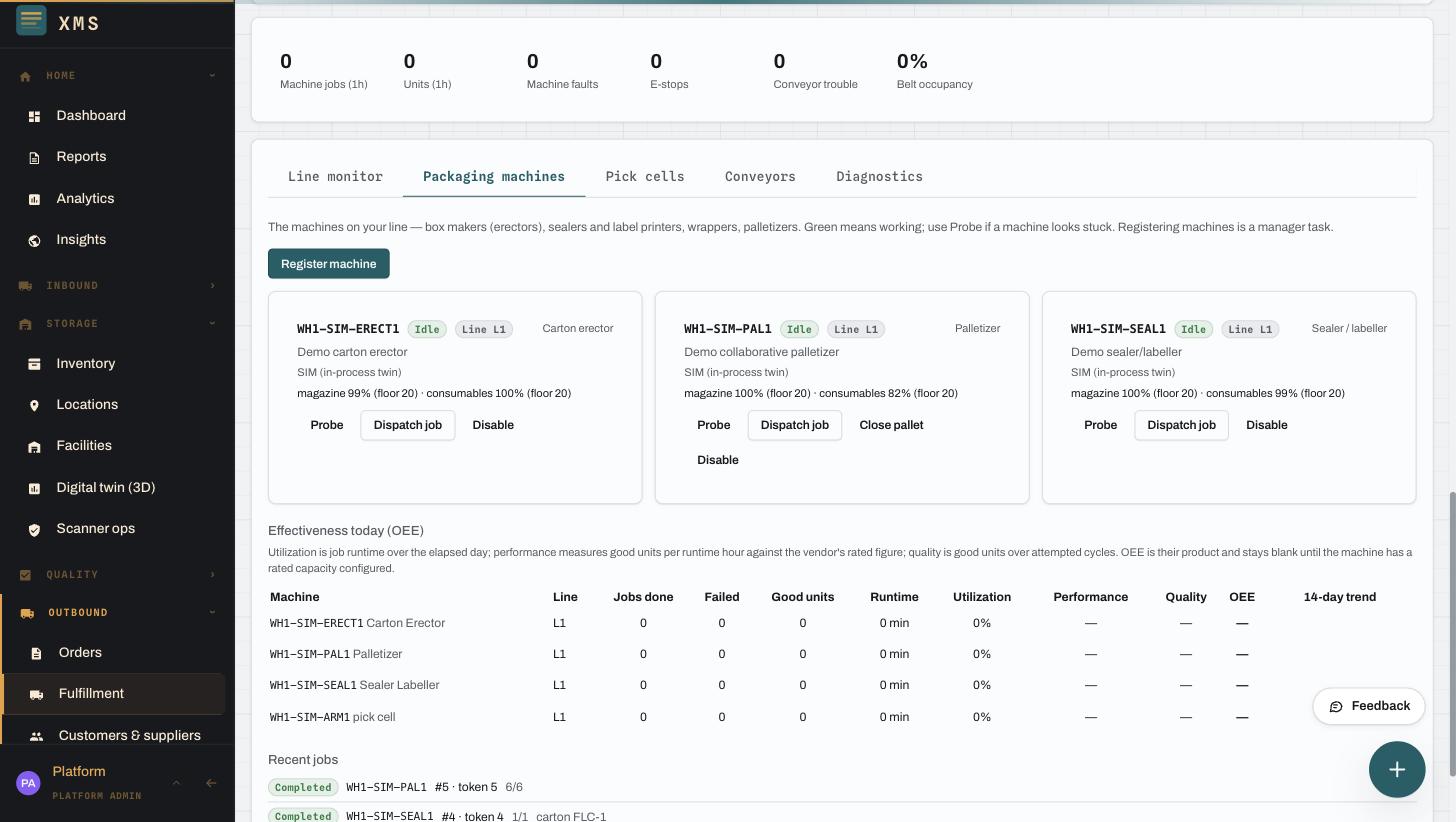
Carton erectors, sealer/labellers, palletizers, conveyors, and supporting machines expose health, consumables, jobs, exceptions, and OEE to warehouse control.
The failure test
Ask for the raw transition evidence. A green equipment tile is not proof that the command was permitted, acknowledged, or physically completed.
Remove E-stop-clear, zone-empty, guard-closed, or upstream-ready from the observed set. The named command must be refused with no tag write.
Return non-Good quality on a bound write or observation tag. The gateway must refuse or preserve not-observed state instead of assuming success.
Issue a permitted command but withhold acknowledgement and completion. The handshake must end timed out and retain the business context for recovery.
An unknown fault must require classification, operator acknowledgement, a complete safe-state checklist, and a manual restart decision.
A missing emulator or replay scenario must appear as uncovered capability bound to adapter and product build—not a generic supported badge.
A lane, cell, or shared resource that disagrees with its reservation must remain an operational divergence until a clean observation or resolution.
Prove before hardware
Simulator adapters and in-process twins exercise missions, reports, exception paths, and UI behavior without claiming a production machine is connected.
Run representative AGV, robot, sortation, MHE, and finish-line workflows before vendor credentials or equipment are available.
Keep simulated, configured, connected, and production-qualified states distinct.
Exercise timeout, rejection, divergence, retry, escalation, and safe restart before go-live.
Review one automation lane
Map missions, safety gates, vendor APIs, programmable logic controller ownership, acknowledgements, exceptions, and recovery.