Demand
Warehouse task names source, destination, load, capability, priority, tenant, and business context.
Mobile-robot integration
XMS Cloud converts warehouse demand into canonical missions, reservations, acknowledgements, and reconciliation. Vendor fleet managers, robot controllers, and safety systems retain route execution, motion, and interlocks.
Mission contract
Warehouse task names source, destination, load, capability, priority, tenant, and business context.
Lease robot, lane, lift, charger, traffic zone, station, or shared resource before dispatch.
Translate canonical mission intent into the configured fleet-master, VDA 5050, per-robot, TCP, or HTTP dialect.
Track accepted, rejected, active, completed, cancelled, timed-out, and physically divergent state.
Cataloged dialects
HTTP fleet adapter with emulator coverage and canonical exchange recording.
HTTP fleet integrations; SL100 D2 is transfer-only with no jack or cruise mission claim.
MQTT fleet dialect with vehicle-negotiated version and topic/security configuration.
TCP binary fleet-master integration; transfer-only with no map or pose telemetry claim.
HTTP order API for master-controlled fleets; sealed transfer orders with no map-raster claim.
Per-robot REST v2.0.0 integration; transfer missions, while robot scheduling owns charging.
In-process adapter for mission, exception, UI, and recovery rehearsal before hardware binding.
Safety and failure boundary
Retain command and business context, stop blind progression, and route recovery ownership.
Do not send jack, pick, cruise, elevator, or charging work to a dialect that does not expose it.
Raise one evolving alert when pose, lane occupancy, load state, or reservation disagrees.
Retry only idempotent handoffs; do not create a second commander or silently duplicate movement.
XMS Cloud does not bypass robot, fleet, PLC, or certified safety behavior.
Vendor firmware, API, protocol, map, or fleet-master changes invalidate stale proof until regression passes.
Fleet supervision
The control surface keeps vendor, robot, battery, pose, mission, reservation, alert, and digital-twin context visible without claiming to be the safety controller.
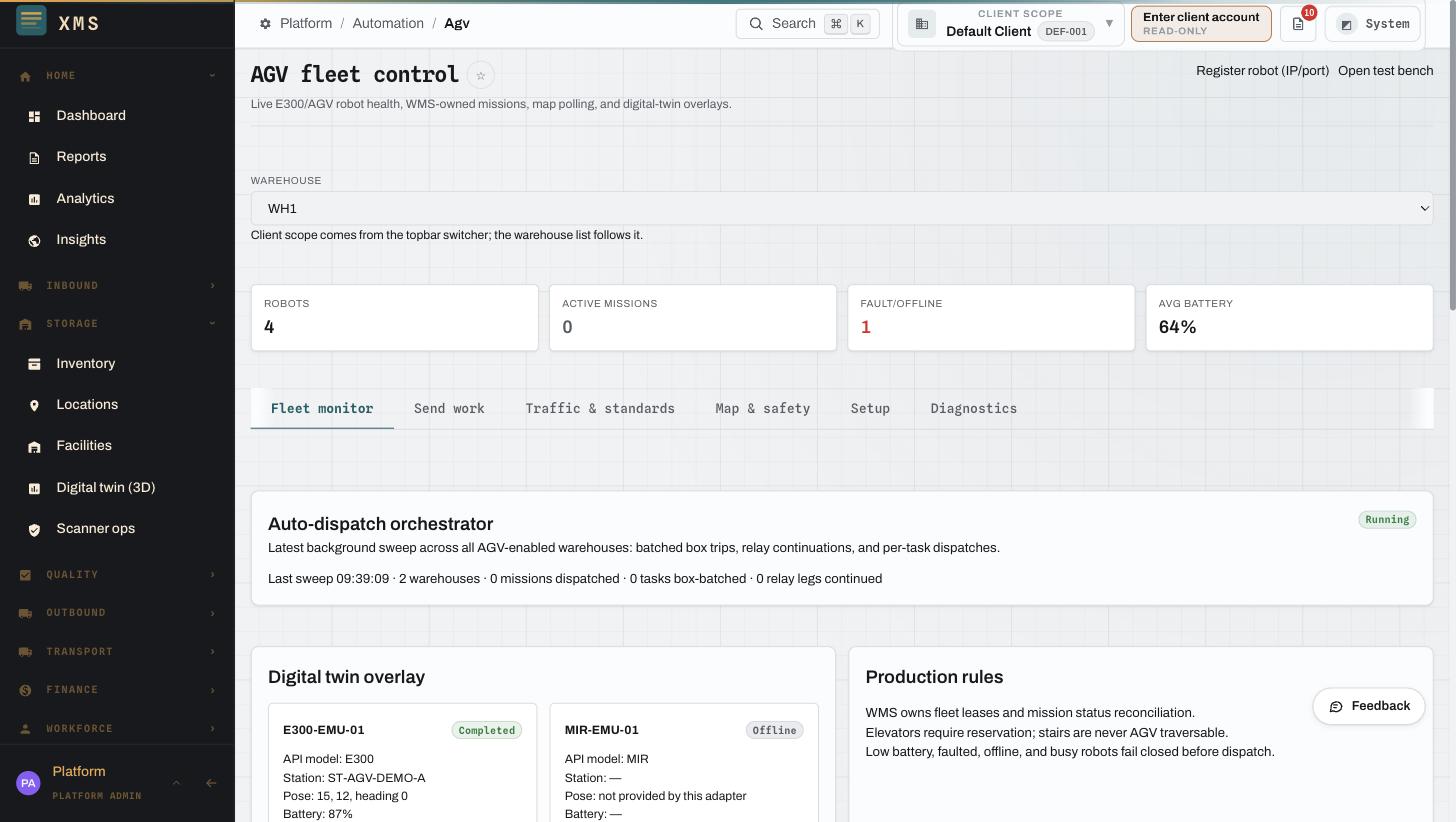
AGV compatibility review
Qualify protocol, authentication, version, topology, acknowledgements, failure behavior, exchange recording, and recovery.