Charge-to-cash guide
Automate billing from governed operational evidence.
A billing engine should not invent revenue from a status label. Service, quantity, tariff, client, source work, adjustment, review, tax, invoice, payment, settlement, and margin must remain traceable.
Evidence-to-invoice loop
Separate measurement, rating, approval, and accounting.
Capture usage
Record handling, storage, order, line, carton, pallet, shipment, return, value-added service, time, and accessorial evidence.
Apply commercial rules
Resolve client, service plan, rate card, tier, minimum, unit, date, currency, tax, override, and pass-through treatment.
Review billing
Explain source, quantity, rate, amount, exception, adjustment, approver, dispute, and excluded usage before invoice issue.
Close finance
Track invoice, credit, payment, allocation, dunning, accounting export, carrier cost, settlement, and margin.
Control questions
Can finance explain every line without asking operations?
Source operation
Each charge identifies the business object, event, service, quantity, actor or machine, time, site, client, and evidence.
Versioned rate rule
Effective dates, units, breaks, minimums, caps, currencies, taxes, accessorials, and overrides retain the applied version.
No silent overwrite
Correction, reversal, credit, waiver, dispute, and reconciliation create explicit linked records rather than editing history.
Sell and buy separation
Client revenue, warehouse cost, carrier buy, provider fee, pass-through, tax, settlement, and recovery keep distinct provenance.
Failure tests
Run the cases that create leakage and duplicate revenue.
Bill once.
Replay the same scan or completion event and verify one usage outcome.
Preserve the applied version.
Change a rate after work and prove the invoice uses the contractually correct effective rule.
Hold for review.
Do not auto-bill a disputed accessorial without the required source proof.
Link correction to source.
Reverse usage or credit an invoice without deleting the original commercial history.
Recover the variance.
Compare contract, shipment, quote, invoice, tolerance, evidence, claim, and settlement.
Deny cross-client billing.
Use direct usage, rate, invoice, payment, and export identifiers across two clients.
Financial visibility
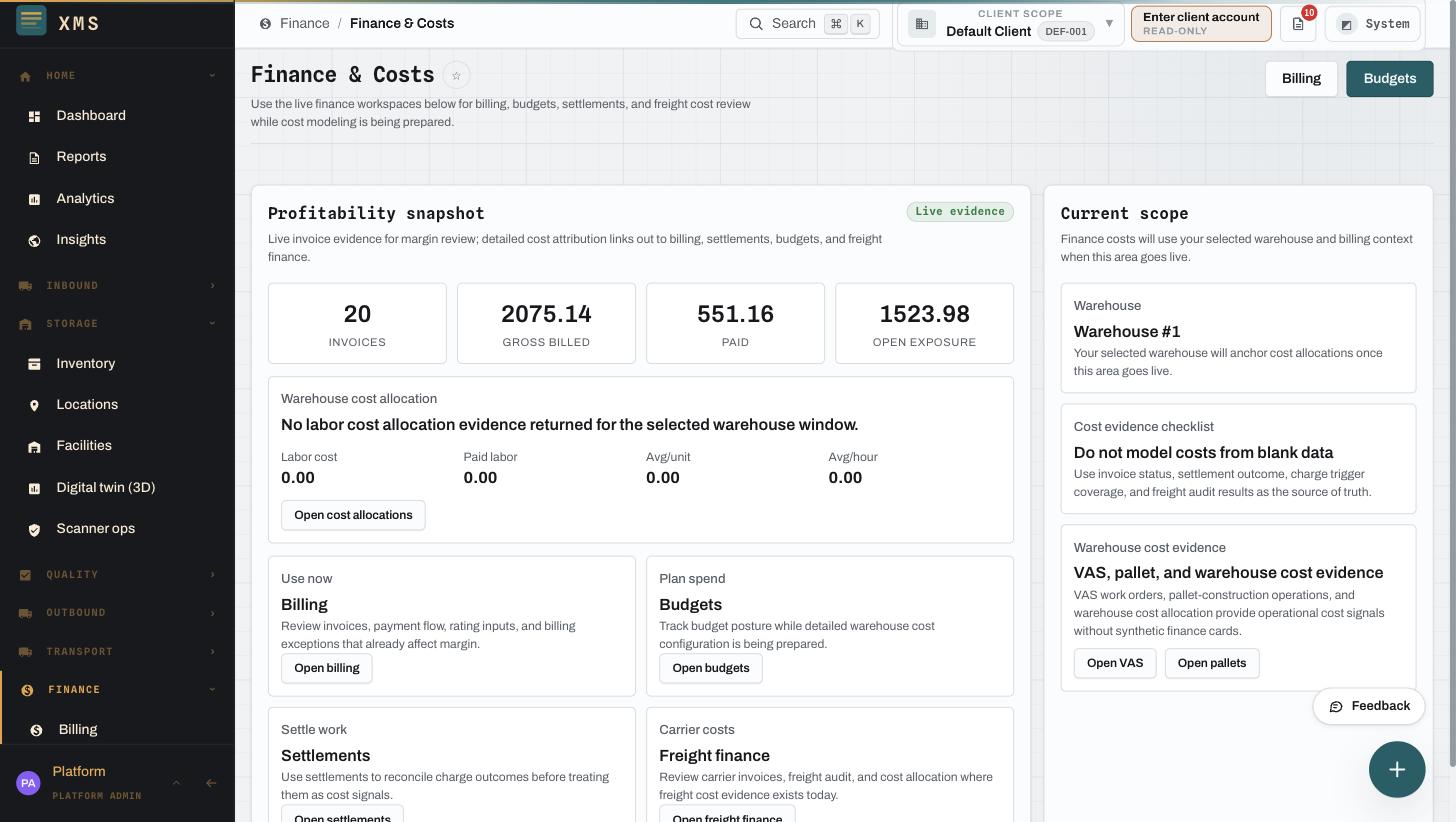
See exposure and profitability beside operations.
Billing automation is useful when finance can move from total to client, invoice, charge, source work, and corrective action without losing context.
- Reviewable usage before invoice.
- Paid, open, disputed, credited, and overdue state.
- Warehouse and transport cost-to-serve.